Be a NURSE Your Country Needs You
Cart (0)

GNM Previous Year Question Paper of Midwifery and Gynecological Nursing Short Question and Answer for GNM 3rd Year

Midwifery and Gynaecology Nursing Previous Year Short Question With Answer

Midwifery and Gynaecology Nursing Previous Year Short Question With Answer

Midwifery and Gynaecology Nursing Previous Year Short Question With Answer

♧Fill in the blanks:

1. The bony canal through which the fetus pass through during birth is ________

➡ Vaginal canal

2. The graphical record of cervical dilatation against duration of labor is________

➡ Partograph

3. The term placenta weighs about_______

➡ 600g

4. The name given to the lochia between 1 and 4 days is called________

➡ Lochia Rubra

5. The biparietal diameter measures about_________

➡ 9.5cm

6. The process of formation of matured ovum in the ovary is___________

➡ Oogenesis

7. The anterior fontanelle is otherwise known as________

➡ Bregma

8. The endometrium after implantation is known as________

➡ Decidua

9. Premature separation of abnormally situated placenta is called_________

➡ Abruptio placenta

10. Physiological anemia during pregnancy is the result of__________

➡ Decreased erythropoietin after the first trimesters

11. The embryotomy measures which is adopted in hydrocephalus to save the life of the mother is said_____

➡ Craniotomy.

12. Prophylactic methergine is administered after the delivery of____________

➡ Baby

13. The type of forceps which is applied when the fetal head is at pelvic outlet________

➡ Wrigleys

14. Painful menstruation is_________

➡ Dysmenorrhea

15.  _________is the name given to the endometrium during pregnancy.

➡ Gravida

16. First milk secreted from the mother is called_________

➡ Colostrum

17.  __________is the graphic representation to assess the progress of labor.

➡ Partograph

18. A dark line running from symphysis pubis to umbilicus during pregnancy is called________

➡ Linea Nigra.

19. Male gonad is__________

➡ Testes

20. Weight of a non-pregnant uterus is__________

➡ 60g

Read More: Community Health Nursing – II Previous Year Short Question With Answer

21.  ___________suture run between the two parietal bones.

➡ Sagittal

22. Posterior fontanelle is otherwise known as___________

➡ Lambdoid

23. The condition where the presentation of the fetus is constantly changing even beyond 36 weeks is________

➡ Unstable lie

24. Inability to conceive the child after regular unprotected intercourse is_________

➡ Infertility

25. Impaired involution of the uterus is called as___________

➡ Subinvolution

26. During abdominal palpation midwife can suspect polyhydramnios by feeling__________

➡ Fluid thrill

27. Brandt Andrews manoveure means___________

➡ Delivering the placenta by cord traction

28. Tenderness of calf muscle on deep pressure in deep vein thrombosis is__________

➡ Homans sign

29. Inflammation of the breast is called__________

➡ Mastitis

30. Absence of menstruation is called___________

➡ Amenorrhea.

31. Inflammation of fallopian tube is called_________

➡ Salpingitis

32. Intermittent painless uterine contractions are called_________

➡ False labor

33. The process by which the reproductive organ return to the pregravid state is called_________

➡ Involusion of uterus.

34.  ____________sign is made out by feeling increased pulsation in lateral vaginal

➡ Osiander’s

35.  __________is the first stool of the baby.

➡ Meconium

36.  _________denotes the perception of active fetal movements by pregnant women.

➡ Quickening

37. __________is the cessation of breathing for more than 20 seconds.

➡ Apnea

38. Women having their first pregnancy at or above the age of 30 years are called_______

➡ Elderly primigravida

39. _________Suture lies between the two parietal bones.

➡ Sagittal

40. The normal weight of the placenta is_________

➡ 600 grams

41.  __________is the dark line running from symphysis pubis to umbilicus during pregnancy.

➡ Linea Nigra

42. __________is the discharge from the uterus following childbirth.

➡ Lochia

43. Implantation occurs at a site other than the utrine cavity is known as____________.

➡ Ectopic pregancy

44. Brownish vaginal discharge is present during pregnancy in case of____________.

➡ Missed abortion

45. The denominator in breech presentation is__________

➡ Mentum

46. Neuromuscular harmony between the upper and lower uterine segment is called___________.

➡ Polarity

47. A women who has never given birth to a viable child is known as_________.

➡ Nullipara

48. Anterior fontanelle closes by_________.

➡ 12 Months.

49. The term used for abnormal labor________

➡ Dystocia

50. Anterior fontanel is otherwise known as___________.

➡Bregma.

51. Craving for non-nutritional substance is known as___________.

➡ Pica.

52. The denominator in face presentation is__________.

➡ Cephalic.

53. Bimanual compression is used in_________

➡ Postpartum hemorrhage

54. Fetal macrosomia is when birth weight exceeds________

➡ 4 kg.

55. Downy hair in the neonates is named as__________.

➡ Lanugo.

56. Weight of a non-pregnant uterus_________.

➡ 50-60 g

57. Planned surgical incision made on posterior wall of perineum____________.

➡ Episiotomy

58. Women in labor is called__________.

➡ Parturient

59. Fetal period begins from___________.

➡ 8th Week.

60. Inability of the new-born to initiate the breach is ______________

➡ Dystocia

61. Excessive vomiting in early pregnancy is known as ______________

➡ Hyperemesis gravidarum

62. The normal length of umbilical cord is _______________

➡ 50 CM

63. The average duration of third stage of labour in primigravida mother is _________________

➡ 10 – 15 minutes

List of Communicable Disease and Their Causative Organism

★DISEASE AND CAUSATIVE ORGANISM★


☆ COMMUNICABLE DISEASE:-  

A communicable disease is one that can spread from one person to another through a variety of ways.

Example:- By direct contact, By blood or body fluids, By droplets, By bitting by an insect.

Disease Name

Causative Organism

Trachoma

Chlamydia Trachomatis

Tetanus

Clostridium Tetani

Leprosy

Mycobacterium Leprae

Gonorrhoea

Neisseria Gonorrhoeae

Syphilis

Treponema pallidum

Yaws

Treponema Pallidum

AIDS

HIV

Smallpox

Variola Virus

Chicken Pox

Varicella Zoster

Measles

Paramyxo Virus

Rubella

Rubella Virus

Mumps

Myxovirus paratiditis

Influenza

Myxovirus

Diptheria

Corrynebacterium Diptheriae

Pertussis

Bordetella Pertussis

Menigococcal Meningitis

Neisseria Meningitidis

Common Cold

Rhino Virus

SARS

Corona Virus

Tuberculosis

Mycobacterium Tuberculosis

Polimyelitis

Polio Virus

Viral Hepatatitis

Hepatitis A, B, C, D,E and G virus

Diarrhoeal Disease

E.Coli Campylobaetor (C

Typhoid Fever (Enteric Fever)

Salmonella Typhi

Food Poisoning 

Escherichia Coli

Amoebiasis

Entamoeba Hystolitica

Ascariasis

Ascaris Lumbricoides

Hookworm infestation

Hookwarms

Dracunculiasis

Guinea worm

Dengue syndrome

Aribo virus 

Cancer of Larynx or Laryngeal Cancer – 2nd Year GNM Medical Surgical Nursing II, Oncology Nursing(Definition,Etiology,Sign & Symptoms,Diagnosis,Treatment & Prevention)

Cancer of Larynx or Laryngeal Cancer - 2nd Year GNM Medical Surgical Nursing II, Oncology Nursing(Definition,Etiology,Sign & Symptoms,Diagnosis,Treatment & Prevention)

CANCER OF LARYNX

Cancer of Larynx or Laryngeal Cancer - 2nd Year GNM Medical Surgical Nursing II, Oncology Nursing(Definition,Etiology,Sign & Symptoms,Diagnosis,Treatment & Prevention)

🔎Definition:

It’s defined as an abnormal or uncontrolled cell growth in any part of the larynx. It is also called Laryngeal Cancer.

🤔Etiology/Causes:

There are not any particular reasons for any types of cancer. It basically happens due to the mutation of DNA in our cells. That is why cancer is called an idiopathic disease.                             

⚠️Risk Factors:

Some common risk factors of the cancer of Larynx are described bellow:

⇢Age – Old age person above 60 to 70 years are more prone to Laryngeal Cancer.

⇢Chewing Tobacco – Chewing tobacco is a very bad habit that not only a worst causes for Laryngeal cancer but also for any other disease.

⇢Drinking Alcohol – Drinking alcohol is a risk factor for cancer.

⇢More risk for men – In surveys it is shown that male are more affected with Laryngeal Cancer as compared to the women.

⇢Chronic laryngitis – Untreated chronic laryngitis further can a cause for Laryngeal Cancer.

⇢Family History – A past family history with laryngeal cancer is a risk factor.

⇢Vocal Straining – Talking loudly like-singer, actor, teacher, public speaker who use their voice regularly may have vocal cord injury. This can lead to laryngeal cancer.

⇢Use sudden medication – Some type of medication and their side effects can leads to Laryngeal cancer.

⇢Nutritional deficiencies – Person with some nutritional deficiency may have the chances of laryngeal cancer.                    

🤧Sign and Symptoms/ Clinical Manifestation:

  1. Hoarseness
  2. Low pitched voice
  3. Difficulty in swallowing          
  4. Blood in spit
  5. Weight loss
  6. Fatigue
  7. Persistent cough
  8. Burning sensation
  9. Difficulty breathing
  10. Ear pain
  11. A sore throat
  12. A lump or sore that doesn’t heal    

𛲢Stages:

Cancer of Larynx or Laryngeal cancer stages are following:

▲Stage 0/Stage I: You have a single tumor in your Larynx.

▲Stage II: You have 2 or 3 tumors and it will be bigger in size than the first stage.The tumor may have spread to your blood vessels.

▲Stage III: In this stage, The tumor may have spread to your lymph nodes, large blood vessels or another organ.

▲Stage IV/Last Stage: In the last stage the cancer will spread to other organs in your body, such as your lungs or bones, as well as lymph nodes.

🩺Diagnostic Evaluations:

‣History collection              

‣Physical Examination

‣Endoscopy

‣Laryngoscopy

‣Biopsy

‣Imaging Tests

        X-ray
        CT scan
        MRI

‣Barium swallow or esophagogram – an Imaging test to show the abnormalities GI tract.

🏥MANAGEMENT:

⇒MEDICAL MANAGEMENT:-

5 Fluorouracil

Ibuprofen(Analgesic)

⇒SURGICAL MANAGEMENT:-

Partial Laryngectomy- Removal of half of the larynx

Total laryngectomy- Removal of full of larynx 

Cordectomy- Removes part or all off a vocal cord

Laser Surgery- Removes a tumor in a bloodless procedure

⇒Other Therapies:-       

Laser Beam- Using radiation it kills the cancer cells.

Chemotherapy – In this therapy chemotherapeutic medications are used to kill or slow the growth of cancer cells.

Immunotherapy – In this treatment health care providers improve our immune system to fight against cancer.

Targeted therapy- Cetuximab is a targeted cancer medicine. In this process medicine helps to stop the multiplication of particular cancer cells or targeted cancer cells.

😖Complication:

  • Spread of cancer
  • Larger tumour size
  • Increased pain and discomfort
  • Difficulty in treatment
  • Reduced quality of life

Liver Cancer – 2nd Year GNM Medical Surgical Nursing II, Oncology Nursing(Definition,Etiology,Sign & Symptoms,Diagnosis,Treatment & Prevention)

Illustration of liver cancer information

Liver Cancer

🔎Definition:

Liver cancer is also known as hepatic cancer, it is the abnormal cell growth or uncontrolled cell growth in liver or any part of liver.

Liver Cancer
Liver Cancer

🤔Etiology/Cause:

There is not any exact cause for any type of cancer that is why cancer is called as an idiopathic disease.

There are many chances of liver cancer which are described in the following as risk factors.

⚠️Risk Factor:

⇢Chronic infection by Hepatitis – Higher rates of liver cancer occur in those patients who have hepatitis B and C infection.

⇢Sex– Males are more often affected  with hepatocellular carcinoma (HCC) than females.

⇢Previous family history– some people with past family history of liver cancer have a increase risk for liver cancer

⇢Genetic cause-Liver cancer happens when liver cells develop changes (mutations) in their DNA of cells.

⇢Age– Old age person are more prone to liver cancer.

⇢Drink Alcohol– Drinking too much amount of alcohol is not good for health. It causes liver cirrhosis and later it transforms to hepatic cancer.

⇢Smoking – Is a greater cause for any types of cancer

Some medication- some oral contraceptive pill also be a risk factors

⇢Cirrhosis– Those person who have previous history of liver cirrhosis

⇢Aflatoxin– Aflatoxin exposure can lead to the development of HCC. The aflatoxins are a group of chemicals produced by the fungi Aspergillus flavus  and Aspergillus parasiticus.

⇢Bad Food Habit– Bad food habit and poor digestion can increase the chances for liver cancer

⇢Chemical Exposure– Certain chemical can also the causes for hepatic cancer

⇢Obesity and other metabolic disease can be the risk factor

🤧Sign and Symptoms/ Clinical Manifestation:

Nausea and vomiting

Sweating

Jaundice

Abdominal pain

Weakness

Fever

Diarrhoea

Splenomegaly – enlargement of spleen

Ascites – Excess abdominal fluid 

𛲢Stages:

Hepatocellular carcinoma or Liver cancer stages are following:

▲Stage 0/Stage I: You have a single tumor in your liver.

▲Stage II: You have 2 or 3 tumors and it will be bigger in size then the first stage.The tumor may have spread to your blood vessels.

▲Stage III: In this stage, The tumor may have spread to your lymph nodes, large blood vessels or another organ.

▲Stage IV/Last Stage: In the last stage the cancer will spread to other organs in your body, such as your lungs or bones, as well as lymph nodes.

🩺Diagnostic Evaluation:

  • History Collection
  • Physical Examination
  • CBC
  • LET(Liver Function Test) – To check if the enzyme, protein and other substance are working properly or not.
  • alpha-fetoprotein (AFT)– High levels of alpha-fetoprotein (AFP) in the blood can be found in many cases HCC
  • Ultrasound
  • CT scan & MRI
  • Angiography- A type of x-ray to show the blood vessles.
  • Biopsy

🏥Management:

  • Surgical Removal of tumor
  • Liver Transplantation – It is the process of placing a good and healthy liver from a healthy donor.
  • Heating Cancer cell- Killing cancer cells by controlled heat.
  • Freezing Cancer Cell- Shrinking malignant cells by too much cold temperature.
  • Injecting Alcohol into the tumor
  • Injecting Chemotherapy drug into cancer cell of liver 
  • Palliative Core

🛡️Prevention:

Reduces exposure to a risk factor for liver cancer.

Stop smoking and alcoholism.

Take healthy diet regularly.

Take vaccine against Hepatitis.


GNM Previous Year Question Paper of Medical Surgical Nursing 2 Short Question and Answer for GNM 2nd Year

Medical Surgical Nursing 2 Previous Year Short Question with Answer

Medical Surgical Nursing 2 Previous Year Short Question with Answer

Medical Surgical Nursing 2 Short Question

Fill in the blanks:

1. Inflammation of the skin is termed as __________

➡ Dermatitis

2. Cancer that arises from glandular tissue is termed as __________

➡ Adenomas

3. AIDS is a ___________viral disease. 

➡ Retro viral 

4. ___________is the cause of amoebic dysentery. 

➡ Entamoeba histolytica 

5. Benign tumor of blood vessels is called____________.

➡ Hemangioma

6. Diminished amount of urine output is termed as_______ .

➡ Oliguria

7. Drug of choice in enteric fever is __________ .

➡ Chloramphenicol

8.  is an inflammation of breast________. 

➡ Mastitis

9. Typhoid fever is cause by_________ organism.

➡ Salmonella Typhi

10. Inability to control emptying the bladder is ___________ .

➡ Urinary incontinence

11. collection of serous fluid in the tinica vaginalis is called as __________.

➡ Hydrocele

12. Inflammation of the prostate gland is said as _________ .

➡ Prostatitis

 13. Diphtheria is cause by________ .

➡ Corynebacterium diphtheria

14. Cancer of the bone is known as_____________.

➡  Osteosarcoma

15. Inflammation of the testis is known as _________________.

➡ Orchitis 

16. BCG vaccine is administered to prevent ________.

➡ Tuberculosis

17. ________ is associated with cancer of oral cavity.

➡ Chewing tobacco

18. Urethral strictures is the common problem after ________. 

➡ TURBT

19. __________ is the surgical removal of tissue.

➡ Debridement

20. _________ is the causative viral agent of herpes chicken pox.

➡ Varicella zoster


Read More: Medical Surgical Nursing 1 Previous Year Short Question with Answer

21. ____________ is the damage to tissue and blood vessels as a result of prolonged exposure to cold.

➡ FROSTBITE

 22. __________ means bleeding from nose.

➡ Epistaxis

23. Deflected nasal septum leads to __________.

➡ Difficulty in Breathing

24. ___________ Maneuver is used for removed of foreign body blocking the upper airway.

➡ Heimitch

25. Pressure on the median nerve at the wrist is turned as

_________. 

➡ Corpal tunnel syndrome

 26. Hardening and thickening of the arteries is known

as_______

➡ Arteriosclerosis 

 27. Inflammation of the gum is called as______.

➡ Gingivitis

28. A bleeding disorder in which the females are the causes and the males are the Suffers__________. 

➡ Hemophilia

29. Fracture of the radius above the wrist is also called

as___________.

➡ Collie’s fracture 

30. Which is the condition caused by the abnormal growth of the spongy bone across the margin of the oval window and the foot plate of stapes _______________.

➡ Otosclerosis

 31.  ____________is loss of bone mass that occurs and predisposing the individual prove to feature. 

➡ Osteoporosis

32.  _________is a condition in which there is pain over the lateral epicondyle of the humor. 

➡ Supracondylar fracture

33. __________ is the inflammation of the cochlea.

➡ Chochlean menieres

34. _________ is the inflammation of Haarl mucosa.

➡ Rhinitis

35. _________means nearsighted.

➡ Myopia

36. Acute peritonsillar absess is known as complication of________.

➡ Acute pharyngitis tonsillitis 

 37. Fracture of the distal end of the radius is _______.

➡ Collies fracture 

38. Inflammation of the pericardium is_________.

➡ Pericarditis

39. _________is the corrective surgery of deviated nasal septum

➡ Rhinoplasty

40.  _________is the excision of posterior arch of vertebr

➡ Laminectomy


Read More: Child Health Nursing Previous Year Short Question with Answer

41. Hypertension is often called as _____________ .

➡ Silent killer

42. Excessive production of tears is known as __________.

➡ Epiphoto

43. Inflammation and Ulceration of the cornea is called_____________. 

➡ Keratitis

44. Folic acid deficiency also causes_____________.

➡ Anemia

45. Rinne’s test is done to assess_______________ .

➡ Hearing

46. The type of deafness caused by cerumen impaction is called____________ .

➡ Conduction hearing loss

47. A peritonsillar abscess is also called as__________.

➡ Quinsy

48 Surgical removal of Breast is called__________ .

➡ Mastectomy

49. Cholera is caused by_________ .

➡ Vibrio cholera

50. Cancer of the bone is known as___________ .

➡ Osteosarcoma

51. Surgical removal of the kidney is termed as __________ .

➡ Nephrectomy

52. Inflammation of urinary bladder is called as____________ .

➡ Cystitis

53. Diphtheria is caused by__________.  

➡ Corynebacterium diphtheriae

54. Inflammation of middle ear is called as___________ .

➡ Otitis media

55. Chewing_____________is associated with cancer of the oral cavity.

➡ Tobacco

56. Dapsone is the drug of choice for__________ .

➡ Dermatitis

57. Twisting of the spermatic cord is called____________ .

➡ Testicular torsion

58. In hypospadias the urethral opening is an____________.

➡ Ventral aspect of the penis

59. Normal serum calcium level is ______________.

➡ 8.9 to 10 mg/dl

60. Instrument used to check reflex is_____________ .

➡ Reflex hammer

61. Spinal anesthesia is a type of___________ .

➡ Regional

62. Antibody mediated immunity is also called as____________.

➡ Humoral immunity


Read More: Mental Health Nursing Previous Year Short Question with Answer

Postpartum Psychosis – 3rd Year GNM, Midwifery and Gynecological Nursing (Definition, Signs and Symptoms,Causes, Diagnosis, Treatment)

A woman with postpartum psychosis holding a baby in her arms.

 POSTPARTUM PSYCHOSIS 

⇒DEFINITION:- 

Postpartum Psychosis is an acute mental disorder or a psychotic reaction occurring following childbirth or abortion. 

🔴Postnatal psychosis or puerperal psychosis is a psychological emergency. 

A woman with postpartum psychosis holding a baby in her arms.
Postpartum Psychosis

⇒CLINICAL MANIFESTATION:-

  1. Hallucinations – sensing falls, visions, smells or sounds which is not really present.
  2. Delusions – It is basically a false belief
  3. Mood changes such as mania or depression 
  4. Depersonalization (some people describe this as an out of body experience) 
  5. Disorganized thinking or behaviours
  6. Insomnia – It is a sleeping disorder in this you may find yourself very hard to stay asleep
  7. Self-harming – Women with this postpartum psychosis have this type of intention to harm themself. She might commit suicide or may try to kill their child.

⇒ETIOLOGY:-

  1. History of Mental Illness – If the patient has any past history of other mental illness.
  2. Schizophrenia 
  3. Bipolar Disorder
  4. Number of pregnancies
  5. family history of mental health condition – If any other family members have any kind of psychotic disorder then the pregnant mother also has a chance to get this mental problem.
  6. Sleep deprivation
  7. Hormone changes – hormonal disbalances due to pregnancy can also be the causes of postpartum psychosis.
  8. Other medical conditions
  9. Post pregnancy stress can affect mothers mental health

⇒Diagnostic Evaluation:-

  • History Collection
  • Physical Examination
  • Blood Test
  • Urine and other body fluid test
  • Mental Status Examination Test
  • Imaging Tests

                ⇾CT Scan
                ⇾MRI

⇒Treatment:-

▲Medication

Antipsychotic

Mood stabilizers

Antiseizure drug

Lithium

▲Electroconvulsive Therapy (ECT)

It is the therapy in which electrical shock is provided to the patient in a very low amount and for very short time only.

⬛ With these proper nursing care is very important to totally cure the mental health problems.

Brain Tumor – 2nd Year GNM Medical Surgical Nursing II, Oncology Nursing(Definition, Types, Etiology, Sign & Symptoms, Diagnosis,Treatment & Complication)

Brain Tumor

Brain tumours are a serious health problem. An untreated brain tumor can become brain cancer in further time. A short note about brain tumors is described below.


➩Definition:-

A brain tumor is a collection of abnormal cells in the brain.

➩Picture:-

A picture of a brain tumor
Brain Tumor


➩TYPE:-

Acoustic Neuroma: A non-cancerous tumor on the main nerve leading from the inner ear to the brain.

Chordoma: Chordoma is a slow growing cancer of tissue found inside the spine.

Craniopharyngioma: Craniopharyngiomas are rare brain tumors that usually form near the pituitary gland and the hypothalamus.

Germ cell tumor: Germ cell tumors are growths of cells that form from reproductive cells.

Gliomas: A type of tumor that occurs in the brain and spinal cord.

Medulloblastoma: Medulloblastoma is a brain tumor of the cerebellum.Medulloblastoma is the second most common brain tumor in children.

➩Etiology:-

There is no actual causes for any cancer that is why cancer is known as an idiopathic disease.

➩Risk Factor:- 

Exposure to radiation – People who are exposed to strong radiation.

Family History – If the patient have any family history of cancer or tumor.

Age – Old age people are most prone to it.

Head Injury – Any past history of head injury can leads to tumor and further go and make cancer.

Seizures

Some changes in DNA can increase the risk of tumor : Cowden Syndrome, Gorlin Syndrome

➩Symptoms:-

  1. Headache, although not always present, is most common in the early morning and is made worse by coughing, straining, or sudden movement.
  2. Nausea
  3. Seizure – A quick sudden abnormal electrical activity in brain cells.
  4. Vomiting
  5. Cognitive changes
  6. Vision change like blurred vision or doubled vision
  7. Papilledema (edema of the optic nerve)
  8. Speech change
  9. Confusion
  10. Memory loss
  11. Hearing problems
  12. Dizziness or sensation of a spinning world.

➩Diagnosis:-

  1. History Collection
  2. Physical Examination
  3. Neurological Examination
  4. Brain CT Scan
  5. MRI on Brain
  6. Angiogram [Diagnostic test which use x-ray show blood vessels]
  7. Biopsy: Taking cell from brain and checking inside the microscope that there is any malignant cells are present or not.
  8. Cerebrospinal Fluid Test
  9. PET ( Positron Emission Tomography )
  10. EEG

➩Treatment:-

▲Medical Method:-

  • Chemotherapy: A variety of medical treatments, including chemotherapy and external-beam radiation therapy, are used alone or in combination.
  • Targeted drug therapy

▲Surgery Method:-

Craniotomy – Remove a part of brain by making a small hole through operation

Endoscopic surgery: Surgery that uses a flexible tube (endoscope) with a light, camera and special instruments to access a tumor. We typically insert the scope through the nose to remove pituitary tumors.

▲Other Therapies:-

  • Radiation Therapy
  • Gene-transfer therapy
  • Brachytherapy (Brachytherapy is a type of radiation therapy use to shrink cancer cells.)

▲Nursing Management:-

  1. Check the general condition of the patient.
  2. Evaluate gag reflex and ability to swallow preoperatively.
  3. Teach the patient about health and healthy food
  4. Perform neurologic checks, monitor vital signs, and maintain a neurologic flow chart.
  5. Monitor patients with seizures.
  6. Check motor function at intervals
  7. Evaluate speech
  8. Assess eye movement, pupil size, and reaction.

➩Complication:-

Hydrocephalus [Excessive Cerebrospinal Fluid inside the brain]

Infection

Death

Cancer of Esophagus – 2nd Year GNM Medical Surgical Nursing II, Oncology Nursing(Definition,Etiology,Sign & Symptoms,Diagnosis,Treatment & Prevention)

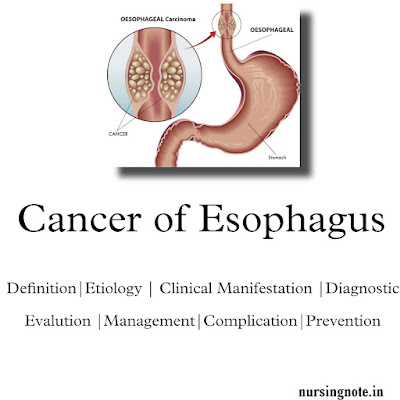
Cancer of Esophagus

➦ Definition:-

It is an abnormal growth of squamous cell present in the lining of the esophagus.

Cancer of Esophagus - Definition,Etiology,Sign & Symptoms,Diagnosis,Treatment & Prevention
Cancer of Esophagus

➦ Risk Factors:-

  1. Gender (male)
  2. Race (African American)
  3. Age (greater risk in fifth decade of life)
  4. Geographic locale (much higher incidence in China and northern Iran)
  5. Chronic esophageal irritation
  6. Use of alcohol and tobacco
  7. Gastroesophageal Reflux Disease (GERD)
  8. Chronic ingestion of hot liquids or foods
  9. nutritional deficiencies poor oral hygiene
  10. exposure to nitrosamines(Organic chemical compound) in the environment or food

➦ Clinical Manifestations:-

  • Nausea
  • Vomiting
  • Dysphagia (Difficult or uncomfortable in swallowing)
  • Feeling of a lump in the throat and painful swallowing
  • Substernal pain or fullness regurgitation of undigested
  • food with foul breath and hiccups later
  • Hemorrhage
  • progressive loss of weight and strength

➦ Diagnostic Evaluation:-

  • History Collection
  • Physical Examination
  • Esophagogastroduodenoscopy (EGD)
  • CT
  • PET
  • Endoscopic ultrasound (EUS),
  • Exploratory laparoscopy
  • Biopsy

➦ Management:-

    ➤ Medical:-

There is no fixed curative medical management of cancer. Treatment of oesophagal cancer is directed toward a cure if the cancer is in the early stage.

    ➤ Surgical:-

Esophagectomy- Removal of esophagus

    ➤ Other Therapy:-

Radiation Therapy
Chemotherapy

➦ Nursing Management:-

1) Advice to avoid spicy food
2) Give more fluid to the Humidifier.
3) Provide medications as per doctor’s order
4) Check temperature, monitor vital signs
5) Check lab result

➦ Prevention:-

  1. Stop smoking
  2. Stop Alcohol Taking
  3. Maintain Proper oral hygiene

Oral Cancer – 2nd Year GNM Medical Surgical Nursing II, Oncology Nursing(Definition,Etiology,Sign & Symptoms,Diagnosis,Treatment & Prevention)

Oral Cancer

➦ Definition:-

It is the abnormal and uncontrolled cell growth and multiplication of cells in the oral cavity. Oral cancer includes cancer of lips cheek, floor of the mouth, soft palate of the mouth, sinuses and pharynx.
Oral Cancer - 2nd Year GNM Medical Surgical Nursing II
Oral Cancer

➦ Causes/Etiology:-

1) Tobacco Smoking
2) Excessive intake of alcohol
3) HPV-Human Papilloma Virus
4) Excessive Exposure in Sunlight
5) Genetic causes

➦ Stages:-

Stage I: Tumour make a lump formation in any part of the mouth.
Stage II: Cancer cells grow regularly and make bigger in size.
Stage III: Cancer spreads nearby organs only.
Stage IV: Cancer spread to the other part of the body.

➦ Clinical Manifestation:-

  1. Lumps or bumps formation.
  2. Swelling area on lips, gums or other areas inside the mouth.
  3. Unexpected bleeding in mouth.
  4. Unexpected numbness, loss of feeling or pain in the mouth cavity.
  5. Difficulties in swallowing or chewing
  6. Hoarseness
  7. Chronic sore throat
  8. A chong in the teeth
  9. Dramatic weight loss
  10. Ear pain

➦ Diagnostic Evaluation:-

1) History collection
2) Physical Examination
3) CT and MRI Scan
4) Biopsy

➦ Management:-

1) Radiation therapy
2) Chemotherapy
3) Maxillectomy
4) Mandibulectomy
5) Glossectomy
6) Combinational (Example – Glossectomy and Laryngectomy)

➦ Nursing Management:-

1) Advice to avoid spicy food.
2) Give more fluid for the Humidifier.
3) Provide analgesic
4) Check temperature, monitor vital signs,
5) Check lab result
6) Provide information to the patient and family of the patient about the procedure.

➦ Complication:-

1) Dysphagia

    2) Speck Speech problem
3) Changes to the appearance of the mouth

Prevention:-

  • Stop smoking
  • Stop Alcoholism
  • Toothbrush regularly
  • Go for a medical checkup if there is any complication.

Cancer – 2nd Year GNM Medical Surgical Nursing II, Oncology Nursing(Definition,Types,Diagnosis,Treatment and Prevention)

Cancer

CANCER

➦ Definition:-

Cancer is the abnormal cell growth or uncontrolled cell growth in any part of our body.
 

Cancer- A short note for GNM students
Cancer

Proliferation:-

is the main characteristic behind tumors and specially malignant ones. Calls growth continuously without being submitted to the local or general controle of the organisms.

➦ Type of Cancer:-

Doctors divide cancer into type based on where it begins. Four main type of cancer are:

  • Carcinomas: A carcinomas begins in the skin or the tissue that covers the surface of internal; organs or glands. carcinomas usually form solid tumours. They are most type of cancer. Example of carcinomas include prostate cancer breast cancer, lung cancer.
  • Sarcomas: A sarcoma begins in the tissues that support and connect the body. A sarcoma can develop in fat, muscles, nerves, tendons, joints, blood vessels, lymph vessels, cartilage, or bone.
  • Leukemias: Leukemia is a cancer of the blood. Leukemia begins when healthy blood cells change and grow uncontrollably. 

         The 4 main types of leukemia are:

                A. acute lymphocytic leukemia
                B. chronic lymphocytic leukemia
                C. acute myeloid leukemia
                D. chronic myeloid leukemia.

  • Lymphomas: Lymphoma is a cancer that begins in the lymphatic system. The lymphatic system is a network of vessels and glands that help fight infection. There are 2 main types of lymphomas: Hodgkin lymphoma and non-Hodgkin lymphoma.

➦ Diagnosing cancer:-

  • History Collection
  • Physical Examination
  • Imaging Test( X-ray, CT Scan, MRI)
  • colonoscopy
  • Biopsy
  • Mammography
  • Pap Smear Test
  • Papnicolanu’s text
  • Stools Or occult blood
  • Sigmoidoscopy
  • Colonoscopy
  • BSE (Breast Self Examination)
  • TSE (Testicular Self Examination)
  • Skin infection

➦ Treatment:-

  • Chemotherapy
  • Radiation Therapy
  • Hormone Therapy
  • Surgical Method
  • Stem cell transplant (bone marrow transplant)
  • Immunotherapy

➦ Prevention:-

  1. Stop smoking
  2. Stop Alcoholism
  3. Take healthy diet daily
  4. Keep away from radiation exposure
  5. Do daily exercises
  6. Do yoga & Meditation

NursingNote.IN

NursingNote is a trusted platform for GNM & Nursing students, providing exam-oriented notes, PDFs, question papers, and career guidance to help you succeed confidently.

Quick Links

Legal